A Worked Example: Reading Two Companies on Stockrita
Walk through two real companies on Stockrita, a large US machinery group and a small Indian cable maker, and see how their filing-sourced relationships bring each business into focus.
The fastest way to show what Stockrita does is to walk through a real company and watch a business come into focus. We will do it twice, with two companies that could not look more different: a large heavy-machinery group in the United States and a small Indian cable maker about to go public. The first walkthrough is the long one, where we show how every part of the page works. The second is quicker, because by then you already know how to read it.
Company one: Oshkosh (United States)
This one is Oshkosh, and you can open its full, live profile as you read.
You have watched its machines go by without knowing it built them. It makes fire trucks, military vehicles, aerial lifts, and refuse trucks, and outside the towns where those plants sit, most people have never heard the name. Hard to read from a price chart. Easy to read from its relationships.
Who it sells to and depends on
On the customer side, the names in its filing tell you who the money comes from: it sells to the United States Department of Defense, the United States Government, and the United States Postal Service. That reframes the whole company. This is a business whose fortunes are tied to government procurement cycles, which behave nothing like consumer demand. On the supplier side, it depends on companies like Dana, which sells Oshkosh the axles and drivetrain parts that go into its vehicles. You would want both of those facts before you formed any view, and here they sit in one view, each counterparty a link, instead of scattered across a long filing.
Who it competes with
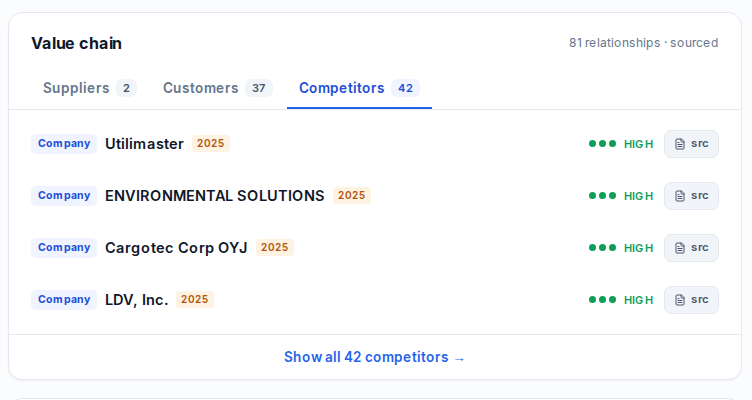
Here the picture fills in. Oshkosh names more than forty rivals in its filing, and the list reaches across the whole global heavy-vehicle world: General Dynamics, BAE Systems, American Rheinmetall, Terex, REV Group, Manitou, Palfinger, Rosenbauer, Rivian, and Chinese machinery makers like XCMG and Zhejiang Dingli, among many others. Read the length and spread of that list and you already know something: this is a business fighting on several fronts at once, against defence primes, European specialists, and low-cost machinery makers in Asia. No single number tells you that. And on the live profile every one of those forty-plus names is a link, so you can click from Oshkosh straight into any rival and read that company the same way.
What it makes, and what goes into it
A relationship view is only half the picture. The other half is what the company actually builds and what it has to buy to build it, and Oshkosh's profile lays both out. On the products side you see the real catalogue behind the vague word "manufacturer": Ground Support Equipment, Aerial Work Platforms, Fire Apparatus, Military Tactical Wheeled Vehicles, and Refuse and Recycling Collection Vehicles, among more than twenty in all.
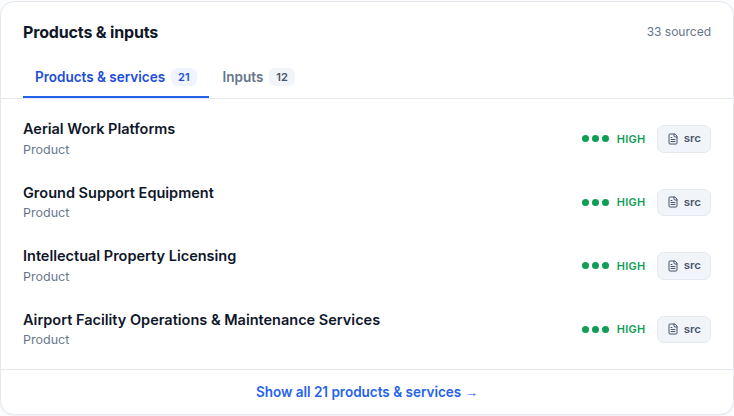
Each product is its own page, and this part is worth slowing down for, because it is a second way of using Stockrita that the rest of this walkthrough relies on. A product page lists the other companies tied to that same product, so from Ground Support Equipment you land on a page about the product itself and everyone else that makes it, beyond the companies Oshkosh happened to name. The same works one level up: the company sits under the Construction Machinery & Heavy Transportation Equipment industry, and that industry is its own page listing every company in it. So a single company is a doorway into its whole product category and its whole industry, and from now on, whenever we mention a product or an industry, that is what a click opens.
On the inputs side you see what the machines are made of: steel, aluminium, copper, engines, axles, and chassis. That is the "picks and shovels" reading in one glance. When steel and copper prices move, this is a company that feels it, and the profile shows you that exposure without you having to dig it out of a cost-of-goods footnote.
How we know: a fact Oshkosh never printed about itself
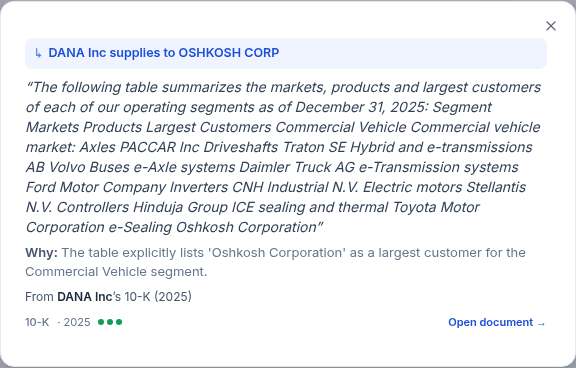
Here is the part that shows why linking companies is worth anything at all. That Dana relationship above was not found in Oshkosh's own filing. It was found in Dana's. Dana's annual report lists its largest customers segment by segment, and Oshkosh is named there. Stockrita read it from Dana's document and attached it to Oshkosh.
Open the source panel on that row and it tells you exactly that: "DANA Inc supplies to Oshkosh Corp," the quoted sentence from Dana's filing, the reason it counts, and the line "From Dana Inc's filing," with a link to open the document itself.
A company almost never lists all of its own suppliers. Their suppliers list them. Because every company in Stockrita is connected, a fact that lives in one company's filing shows up on the other company's page, sourced and dated. Every relationship on the page carries that same source panel, so you can check anything you doubt. Keep it in mind, because it is the single most important thing to understand about the second company too.
The group it sits in
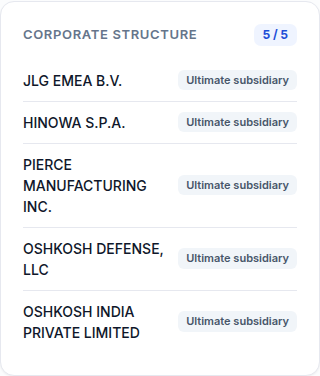
If a company is part of a larger group, the ownership view shows it, and here Oshkosh sits at the top. It is the ultimate parent, and beneath it are real operating businesses you may know better than the parent itself: Pierce Manufacturing for fire trucks, JLG for aerial lifts, and Oshkosh Defense, plus units in India (Oshkosh India) and Italy (Hinowa). All five are subsidiaries of Oshkosh; Oshkosh itself is a subsidiary of no one. Each is its own linked page, so that structure is something you can open and explore, and it tells you what you actually own when you buy one share, several distinct manufacturing businesses under one roof.
That is one company read end to end: who pays it, who it fights, what it makes, what it buys, a fact its own filing never printed, and the group it owns.
Company two: Lumino Industries (India)
Now watch the same page do the same work on a company at the opposite end of the size scale, in a different country. This one is Lumino Industries, a small Indian manufacturer that was about to go public when this was written. You already know how to read the page, so this goes faster, and we will point out only what is new.
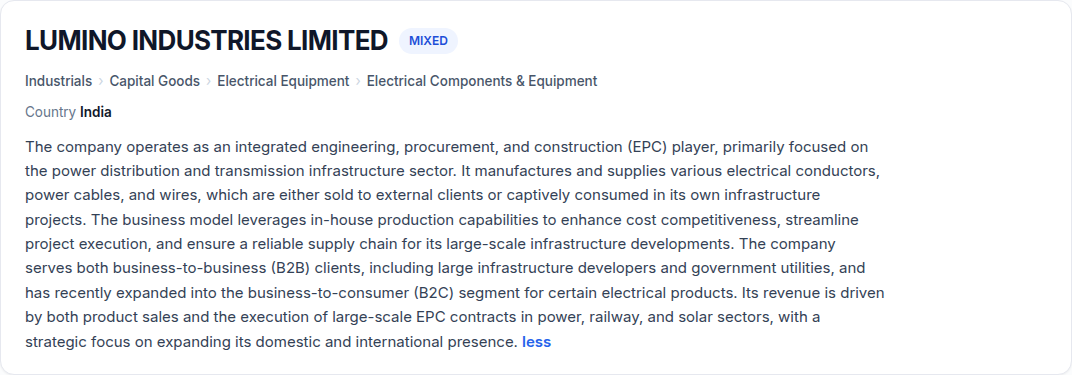
Where Oshkosh is a large group with brands beneath it, Lumino is a single young company. It makes power cables, aluminium conductors, and electrical wires, and it builds transmission lines and substations. Almost no one outside its industry has heard of it, which is exactly why the structure of the business is worth more here than a name ever could be.
Who it sells to
Where Oshkosh sold to the United States government, Lumino sells to the companies that build and run India's power grid: the Central Transmission Utility of India, state distribution companies like Assam Power Distribution and West Bengal State Electricity Distribution, and large engineering firms like Kalpataru Projects. Same idea as before, each customer a link, and the same lesson lands instantly: this is a business whose revenue rides on government and utility spending on the grid, not on consumer demand.
Who it competes with
The rival list is a fast lesson in the Indian cables-and-transmission market: KEC International, KEI Industries, Apar Industries, Sterlite Power, Universal Cables, and Bajel Projects. Here the walkable list tells you something Oshkosh's did not: Kalpataru Projects appears as both a customer and a competitor. That is not an error; it is the reality of this industry, where a big engineering firm buys your conductors on one project and bids against you on the next. Several of these rivals are far larger than Lumino, and clicking through them is how you size up what a new public company is walking into.
What it makes, and what goes into it
The products are specific: Power Cables, Aluminium Conductors, Electrical Wires, and services like EHV Substation EPC and Railway Electrification. As with Oshkosh, each product is its own page into everyone else who makes it, and the company sits under the Electrical Components & Equipment industry page, the same doorways opening onto a different room. And its inputs are the tell for a cable maker: copper rods, aluminium ingots, steel, XLPE and PVC compound. When copper and aluminium prices move, this company feels it directly, and the profile shows that exposure plainly.
The fact Lumino never printed about itself
The reverse-link trick you saw with Dana works here too, and for a company this new it matters even more. You learn more than what Lumino says about itself. A wire maker, Kritika Wires, lists Lumino among its clients in its own filing, and Sterlite Electric names Lumino among the key players in the power-cables industry in its filing. Open the source panel on either and it names whose filing the fact came from, quotes the sentence, and links to the document, exactly as it did for Oshkosh. For a company about to list, that outside confirmation, other filings placing it in the market, is a second opinion you could never get from reading Lumino alone.
Notice one more thing about Lumino's page. Oshkosh's profile showed a group of subsidiaries sitting beneath it; Lumino's corporate-structure section reads 0 / 0. Read that correctly: it means we did not find corporate-structure information for this company from any reliable source or document, not that Lumino has no such structure. Stockrita leaves a section blank rather than guessing, and it can fill in later if a reliable source turns up. What is on the page stands on evidence; what is not there simply has not been established yet.
What you just did, twice
You took two companies you probably could not have described, one a large American group and one a small Indian company about to go public, and in a few minutes you had a real picture of each: who pays it, who it fights, what it makes, what it depends on, and a fact its own filing never printed. Nothing about how you read the second page was different from the first. That is the point. Once you can read one company on Stockrita, you can read any of them, large or small, American or Indian, decades old or days from its IPO.
And the relationships come straight from the filings, each one with its source a click away. You bring your own view on what a company is worth. Stockrita shows you the shape of the business it sits inside, so your judgment has something solid to stand on.